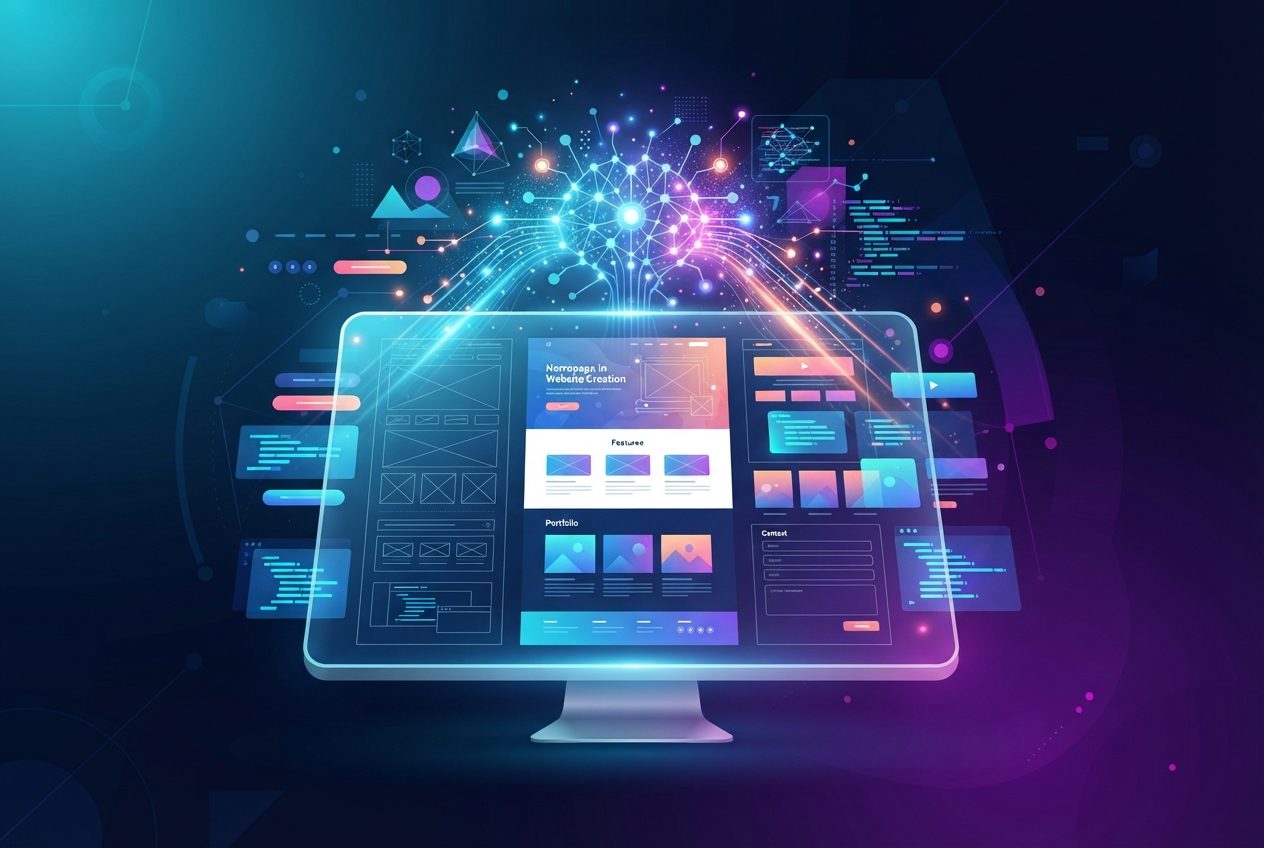
Advantages, disadvantages, and future prospects
Artificial Intelligence (AI) has become one of the most important driving forces behind digital transformation, significantly influencing how websites are designed, developed, and maintained. From automated code generation and graphic interface creation to user experience optimization and programming error detection, AI-powered tools offer capabilities that, until recently, required considerable manual effort and technical expertise.
In web design, artificial intelligence is no longer just an automation tool. It has become an assistant capable of supporting the entire web development process. However, integrating this technology brings both significant benefits and certain risks and limitations. To understand the real impact of AI on the industry, it is essential to examine the advantages and disadvantages of using it in programming and website development.
1. Automating the Web Development Process
One of the most significant effects of artificial intelligence is the automation of tasks that traditionally required direct involvement from developers. AI tools can generate HTML, CSS, JavaScript, PHP, or Python code snippets based on instructions written in natural language.
For example, a developer can request the creation of a presentation section for a corporate website, including a heading, subtitle, call-to-action button, and background image. AI can quickly generate the necessary HTML structure and CSS styles, reducing the time required for initial implementation.
Artificial intelligence can also assist in developing reusable components, generating forms, implementing responsive navigation menus, and integrating JavaScript functionalities.
This does not mean that developers are becoming obsolete. Instead, their roles are evolving. Rather than manually writing every line of code, developers can dedicate more time to application architecture, user experience, performance, and security.
2. Five Advantages of Using Artificial Intelligence in Programming and Web Design
1. Reduced Development Time
The main advantage of using AI is increased productivity. Automated code generation, code completion, and rapid creation of functional structures allow developers to save valuable time.
Tasks such as building layouts, configuring CSS components, or writing basic JavaScript functions can be completed much faster. As a result, the time saved can be invested in activities that require greater attention, such as testing, optimization, and project customization.
2. Assistance with Error Detection and Debugging
AI tools can analyze source code and identify various syntax issues, logical errors, and inefficient implementations.
For example, a developer can provide a PHP code snippet that generates an error, and AI can explain the problem and suggest a corrected version. In JavaScript, it can identify potential issues related to DOM manipulation, event handling, or data management.
This functionality is useful for both experienced developers and beginners, as it provides additional explanations and faster solutions.
3. Greater Accessibility for People Without Advanced Programming Experience
Artificial intelligence makes web development more accessible to people who do not have extensive programming knowledge.
By using natural language prompts, users can request the creation of website sections, modify visual styles, or implement basic functionalities.
For example, someone with a basic understanding of HTML and CSS can use AI to build a landing page or a business website without having to master every technical detail.
4. Faster Generation of Design Ideas and Solutions
AI can contribute to the creative process by suggesting visual structures, color combinations, layout variations, and interface concepts.
During the prototyping stage, developers can request multiple versions of the same page and compare them based on the project's objectives.
AI tools can also generate website copy, product descriptions, and content organization suggestions. These capabilities can improve collaboration between developers, designers, and marketing specialists.
5. Optimization and Improvement of Existing Code
Another important advantage is the ability to analyze and optimize existing code.
AI can recommend simplifying functions, removing redundant elements, and reorganizing components to improve maintainability. In projects using frameworks such as React, Vue, or Angular, AI tools can provide suggestions regarding component structure and code reusability.
Furthermore, AI can help identify potential performance, accessibility, and cross-browser compatibility issues, contributing to a better-optimized digital product.
3. Five Disadvantages of Using Artificial Intelligence in Programming
Despite its obvious benefits, artificial intelligence is not without risks. Automatically generated results must be reviewed and verified because AI cannot guarantee that every proposed solution is technically correct.
1. Generating Incorrect or Inefficient Code
One of the main disadvantages is that AI can generate code that appears correct at first glance but contains errors or fails to meet the actual requirements of a project.
In some cases, suggested solutions may rely on outdated methods, incompatible libraries, or implementations that do not work in specific environments.
For this reason, code review by a developer remains essential. Generated code must be tested, analyzed, and adapted before being used in a real-world project.
2. Application Security Risks
Security is a critical aspect of website development. AI-generated code may contain vulnerabilities such as insufficient input validation, incorrect authentication handling, or exposure of sensitive information.
For example, improperly implemented SQL queries can introduce SQL Injection risks, while inadequate handling of user input can create Cross-Site Scripting (XSS) vulnerabilities.
AI can help identify some of these issues, but it cannot replace a professional security audit and testing process.
3. Excessive Dependence on AI Tools
Constant reliance on artificial intelligence may cause some developers to become overly dependent on automatically generated solutions.
Instead of understanding how the code works, they may end up copying and implementing solutions without properly analyzing them.
In the long term, this approach can negatively affect problem-solving abilities, understanding of software architecture, and the development of technical skills.
AI should be used as a supporting tool, not as a substitute for fundamental programming knowledge.
4. Limitations in Understanding Context and Complex Requirements
Although modern artificial intelligence models can process large amounts of information, they do not always fully understand the context of a project.
A complex website may have specific requirements involving brand identity, third-party integrations, user workflows, database architecture, or business logic.
When instructions are incomplete, AI may generate a solution that works independently but does not integrate properly into the application's overall architecture.
This is particularly important in custom development projects, where every component must comply with specific technical rules and dependencies.
5. Originality and Design Quality Issues
Using AI in web design can lead to similar-looking interfaces based on commonly used visual patterns.
Although these tools can quickly generate modern layouts, the results are not always original or aligned with a brand's identity.
A professional website is more than an attractive design. It also requires a consistent user experience, a well-defined visual hierarchy, and a structure built around users' needs.
Therefore, the involvement of a designer remains important for visual differentiation and the development of an authentic digital identity.
4. The Impact of AI on Modern Web Development Technologies
The integration of artificial intelligence is influencing numerous technologies used in web development. On the frontend, AI can assist with generating HTML, CSS, and JavaScript components, as well as building user interfaces using modern frameworks such as React, Vue, and Angular.
On the backend, AI can provide assistance with API development, application logic implementation, database management, and third-party service integration.
Modern tools can also help automate testing, documentation, and debugging processes. Combined with version control systems such as Git and collaborative development platforms, these tools can streamline the entire development workflow.
Another important area is performance optimization. AI can help analyze issues such as slow resource loading, excessive file sizes, inefficient JavaScript execution, and poorly structured code.
However, all recommendations should be validated using specialized testing and monitoring tools.
5. Artificial Intelligence and the Future of the Web Developer Profession
The rapid development of AI tools raises important questions about the future of the web development profession. While automating certain programming tasks can change how projects are built, it does not eliminate the need for human expertise.
On the contrary, fundamental technical skills are becoming even more important. Developers must be able to evaluate generated code, understand application architecture, identify vulnerabilities, and make sound technical decisions.
In the future, the competitive advantage will not rely exclusively on the ability to write code quickly. It will also depend on the ability to use AI tools effectively, formulate precise instructions, and integrate generated solutions into functional systems.
As a result, collaboration between artificial intelligence and human expertise will become an essential part of digital project development.
Conclusion
Artificial intelligence represents a major shift in the web design and website development industry. Its ability to generate code, identify errors, suggest visual solutions, and optimize technical processes offers significant advantages in terms of productivity and efficiency.
However, the risks associated with incorrect code, security vulnerabilities, technological dependency, and lack of originality should not be overlooked.
The most effective approach is to use AI as a complementary tool within a development process guided by experienced professionals. Artificial intelligence can accelerate a developer's workflow, but experience, critical thinking, and the ability to understand users' actual needs remain fundamental to building high-performance, secure, and well-structured websites.





No Reviews yet
Be the first to review this post.